This project started with by modeling the computational thinking behaviors that neurodiverse individuals exhibit in 3D online virtual worlds. To do this our team developed and validated an evidence-centered computational thinking model and used it to code the behaviors of adolescents with Autism while engaging in design-based problem solving asks in the virtual world. Below are some screen grabs of participants engaging in various design-based problem solving tasks in the virtual world.
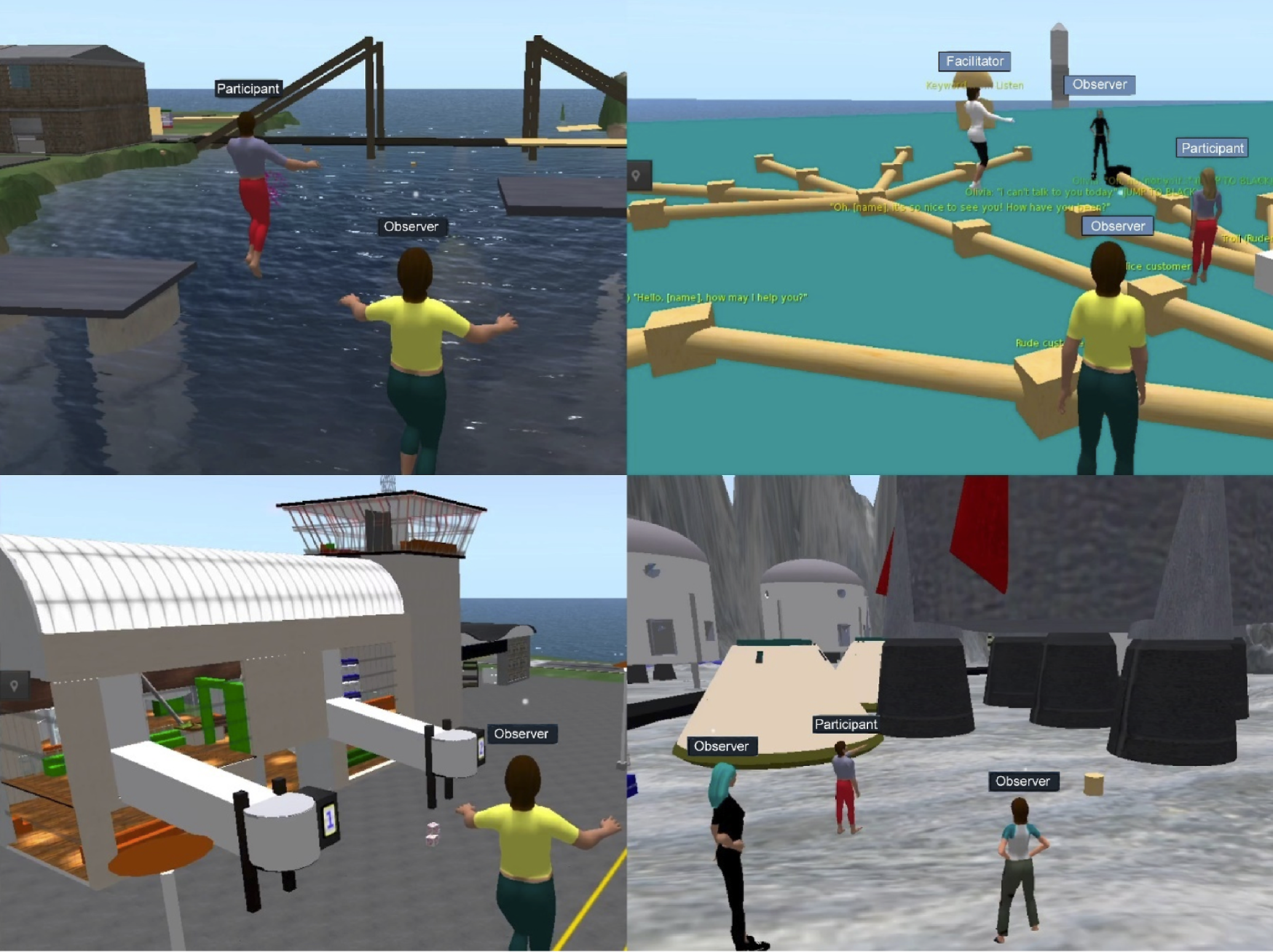
Stemming from this research, our team started grounded research in educational access for neurodiverse individuals. We have a literature review manuscript currently under review which encompasses research on care ecosystems for neurodiverse individuals in rural areas.
Highlights
- Virtual Worlds are effective online education tools that remain highly performance oriented.
- There are substantial challenges in behavioral observation research in virtual world contexts.
- Rural care ecosystems for individuals with neurodiversity lag behind urban systems in immediacy and variety of access.
Next Steps
- Exploring technology interventions that can enhance care ecosystems in rural areas.
- Latent growth curve analyses of behavioral observation data.
Representative Publications
Zhang, N., Ke, F., Barrett, A. & Sokolikj, Z. (2024). Improving computational thinking for learners with autism in the virtual world: A longitudinal study. The 10th International Conference of the Immersive Learning Research Network (iLRN2024), 164-169. https://doi.org/10.56198/U6C0WYZ8W
Barrett, A., Zhang, N., Ke, F., Moon, J. & Sokolikj, Z. (2022). Developing an evidence-centered model for computational thinking in virtual worlds with children with autism. The 8th International Conference of the Immersive Learning Research Network (iLRN2022), 30-32. https://doi.org/10.23919/iLRN55037.2022
Barrett, A., Ke, F., Zhang, N. & Sokolikj, Z. (2025). Implementation fidelity of an evidence-centered maker education intervention in a virtual world for neurodiverse adolescents. Computers & Education: X Reality, 7, 100106. https://doi.org/10.1016/j.cexr.2025.100106
Works-in-Progress
Zhang, N., Ke, F., Barrett, A., Kim, C. & Xu, J. (Under Review). Assessing rural care ecosystems for individuals with neurodiversity: A systematic literature review. Review of Educational Research.
 Alex Barrett