This ongoing project investigates how learners perceive and respond to immersive media and technologies. Early stages of the project involved multiple cross-functional collaborators for designing and developing novel immersive learning environments in virtual reality (VR). Our team collected user experience (UX) data and compiled a causal mode to understand how the unique affordances of VR impact attitudes toward the technology for learning purposes.
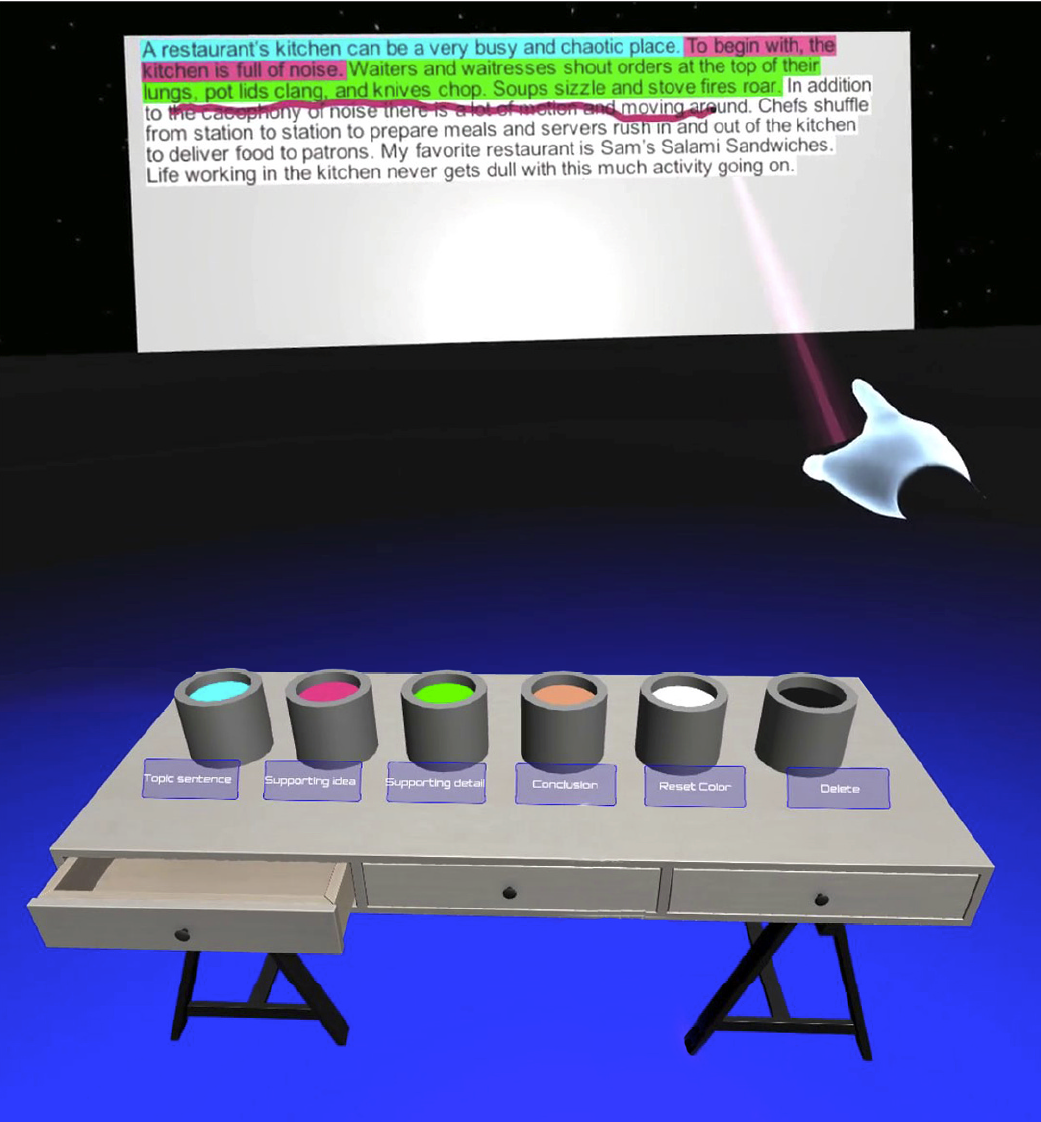
This image depicts an immersive learning environment for the purpose of learning academic writing structure for English L2 learners.
Another environment we utilized is Mozilla Hubs, where we were able to create an interactive and immersive environment for Chinese L2 learners.
A recent project took a more grounded theory approach to immersive learning. Our team integrated dual-coding and multimedia-learning research with the presence and immersion literature, positioning narrative absorption in immersive learning theory. This research opens multiple possibilities for immersive learning that that are alternative to the technological determinism often found using VR.
Highlights
- Immersion precedes interactivity and presence in sensory immersion experiences.
- Immersion has a large impact on learner motivation.
- Narrative media for learning reduces cognitive load and enhances mental imagery.
Next steps
- multi-modal integration: How can multiple immersive stimuli be integrated for optimal learning?
- Neurodiversity and immersion: How can individuals with ADHD benefit from immersion? How to individuals with Autism experience immersive stimuli?
Representative Publications
Barrett, A., Zhang, N. & Wei, S. (2025). The virtual reality in our head: How immersion and mental imagery are connected to knowledge retention. Educational Psychology Review, 37(9). https://doi.org/10.1007/s10648-025-09984-4
Barrett, A., Pack, A., Monteiro, D. & Liang, H.-N. (2023). Exploring the influence of audience familiarity on speaker anxiety and performance in virtual reality and real-life presentation contexts. Behavior & Information Technology, 43(4), 787-799. https://doi.org/10.1080/0144929X.2023.2186145
Barrett, A., Pack, A., Guo, Y. & Wang, N. (2021). Technology acceptance model and multi-user virtual reality learning environments for Chinese language education. Interactive Learning Environments, 31(3), 1665-1682. https://doi.org/10.1080/10494820.2020.1855209
Works-in-Progress
Barrett, A., & Moon, J. (Working paper). Immersion in multimedia: Investigating perceptions of place illusion in narrative texts.
 Alex Barrett